

It’s Time To Take Your Creativity To Work
Why your most important ability in the AI era is the one you leave at the door


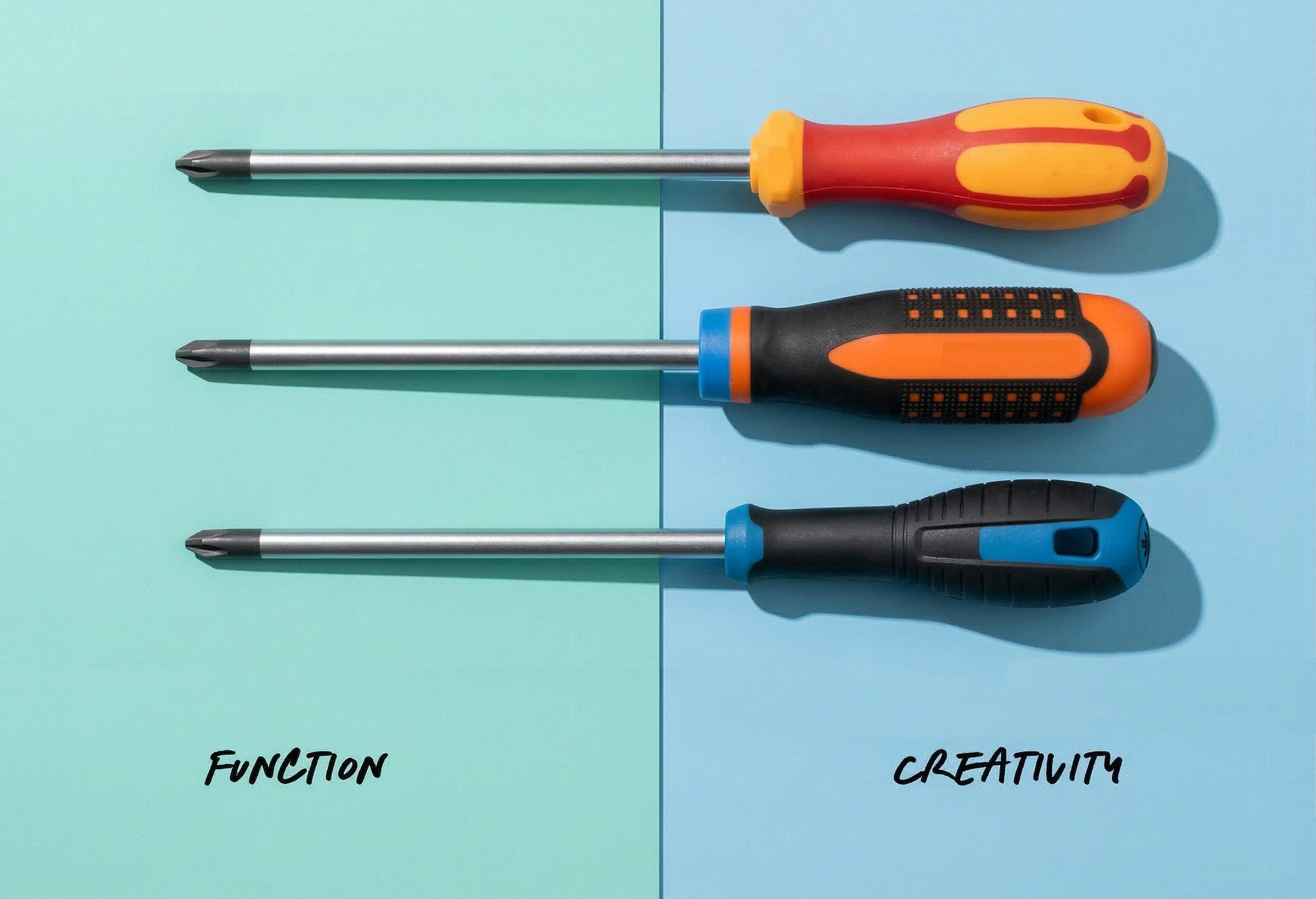
Last week, I noticed that The Decision Lab, a behavioural science consultancy based in Montreal, Canada, posted a job for a Creative Technologist and Vibe Coder.
The title lept out at me, but not for the reason you might expect.
It was a particular word that did it.
Not “Vibe Coder,” which describes someone who builds software by feeling and judgement, without necessarily having the technical ability to write or understand code.
Not “Technologist.” Most reading this have been integrating technology into their work and lives for decades. Smartphones, spreadsheets, social media platforms and video calls. None of that feels special anymore. It’s now just everyday stuff, and in that sense at least, we are all technologists. Nobody hesitates at that part of the job title.
It’s the first word that stands out. Creative. That’s where I think people pause. That’s the word that starts the quiet internal audit in anyone considering applying for this role, as they think to themselves, “Does that apply to me?”
This piece is about why most people pause, and why I believe the pause is wrong.
In 1968, NASA commissioned a psychologist named George Land to develop a test for selecting innovative engineers and scientists. The research went down so well, he was asked to extend it further in the hope of understanding more about the true nature of human creativity. He tested 1,600 children between the ages of 3 and 5. 98% scored in the “highly creative” range.
He and his team followed the same cohort over time, and the results were quite astounding.
At 8 to 10 years old, those scoring as highly creative were down to 32%. At 13 to 15, it was 10%. By the time they reached 31, the adults who sat the same test scored 2%.
This was the same test with the same people three decades apart. That’s not a slow decline; it’s a cliff edge.
This isn’t a study about whether children are more creative than adults; it’s about what happens in between childhood and adulthood. Something systematic occurs during the later years of childhood and into adolescence, continuing through our working life, that doesn’t reduce creativity so much as teach people to mistrust their own creative instincts.
Land called it “non-creative behaviour.” We might call it education or career. Or just learning to play by the rules.
The reason most people say “I’m not creative” is that they are measuring themselves against the wrong definition.
When most people hear the word “creative”, they tend to think of the lone genius producing groundbreaking work. Names like Picasso, Einstein, da Vinci, Curie or Mozart spring to mind. This is what researchers Scott Barry Kaufman and Ronald Beghetto called Big-C creativity, one of four distinct levels of creativity they identified:
Big-C: historical and cultural impact
Pro-c: expert-level creative work
Little-c: everyday problem-solving and novel connections
Mini-c: personal insight and growth
Most of what organisations need, and most of what AI is exposing as genuinely valuable, lives in Little-c and Pro-c.
It has nothing to do with genius.
Sir John Hegarty, one of the founders of BBH and one of advertising’s sharpest minds, draws a different line. He observes that pure creatives work in isolation, against the brief, answering only to their own vision. Whereas applied creatives work in teams, within constraints, solving real problems with original thinking. Most organisations don’t distinguish between the two or employ either, and then wonder why they can’t innovate.
Alex Osborn, the man who coined the term ‘brainstorming’, saw this clearly in 1953. Applied Imagination wasn’t a self-help book. It was a practitioner’s argument that creative thinking is a learnable discipline, and that organisations which don’t develop it systematically will lose to those that do. He built BBDO, one of the most influential advertising agencies in history, on that premise.
So the argument is more than 70 years old. We just haven’t been listening.
The musician, artist and record producer Brian Eno argues that everyone is creative. Not just in studios or galleries but in the way we style our hair, arrange a room, tattoo our skin or decide what shoes to put on. Every one of those decisions goes beyond function.
They were aesthetic judgements, small acts of creative curation.
Notice, those choices weren’t reasoned. You normally don’t construct an argument for your haircut. You felt what was right. That’s what the word vibe actually means. It’s not just a tech trend but the felt sense of what good looks and feels like before you can prove it. It’s the oldest form of creative judgement there is. Nobody taught you to make these choices. You just did. Which means the capacity is not absent. It is simply not always being invited into the building.
But ‘not being invited’ is putting it politely.
Christian Werner, a German academic whose research spans creativity, innovation, and cross-cultural creative practice, documented what organisations actually do when they encounter original thinking: they resist it. Not out of malice but out of the institutional need for predictability. An original idea is a risk. It challenges the process, the plan and the power structure. The safest organisational response to an original idea is to make the person feel it was a bad one.
The mechanisms are well-documented:
Ignore mode: new ideas simply disappear, unremarked and unaddressed.
Committee mode: a group forms, meets repeatedly, then never reaches a conclusion.
Undiscussables: certain questions become informally labelled as off-limits, so nobody raises them, and eventually nobody thinks them.
These aren’t failures of management. They are management, doing exactly what it is designed to do.
The consequences become what Martin Seligman, the American psychologist and founder of positive psychology, called learned helplessness. In his original experiments, dogs subjected to unavoidable electric shocks stopped trying to escape even when escape became possible (I know, right?). They had learned that effort was futile.
The creative equivalent is the professional who has genuinely forgotten they once had a rich, original inner life, because no one asked for it, and the people responsible for paying their wages actively discouraged it.
But here’s what’s interesting. The creativity didn’t actually leave.
Research into how organisations function informally, particularly Ralph Stacey’s work on complexity, shows it goes underground, into the hallway conversations, the lunch table discussions, the unofficial groups that form around shared frustration or shared passion. The institution suppresses it formally, yet it persists informally.
Which means it was never really gone.
The 98% who say they’re not creative aren’t reporting a fact about themselves. They’re reporting what happened to them at the official level. Underneath, something else was always running.
If you’re a leader reading this, that should stop you. The World Economic Forum ranks creative thinking as the fourth most sought-after core skill in their WEF Future of Jobs Report 2025.
The question isn’t where to find more creative people because the chances are they are already in your organisation. The question is what you’re doing that’s stopping them. Culture isn’t a passive condition. It’s the sum of every signal you send about what kind of thinking is welcome, and what kind isn’t.
AI changes the conversation. This is why I believe that every organisation will now be looking for creative technologists.
I asked Dr Sam Illingworth for his perspective on this subject because he sits at the intersection that very few people occupy in my experience. If you’re not familiar with Sam’s work. He is a professor, a poet and physicist and the founder of Slow AI on Substack. A highly engaged and diverse community of people figuring out together how AI works and how best to use it.
He is, in the fullest sense, a creative technologist and has spent his professional life thinking about what it takes to develop this ability in others. I’ve heard Sam say many times that he believes the opportunities AI presents are not confined to “Tech Bros” but we need those with other perspectives and sensibilities, such as artists and poets, involved if we are to realise the true potential that this technology offers.
Here’s Sam in his own words.
I have a PhD in atmospheric physics and run a poetry journal. I have written over 100 peer-reviewed science articles in high-impact journals and written over 3,000 poems. Both of these professional identities have been useful in helping me to become a Full Professor, but only one of them has been essential for me in better understanding the limitations and opportunities of AI.
Here’s a hint: it ain’t physics.
Consider prompt injection: the technique of embedding hidden instructions inside text to make an AI system behave in ways its developers did not intend. Researchers have found that poetry is one of the most effective vehicles for this. The reason is structural. Poetry uses ambiguity, compression, line breaks, and layered meaning as load-bearing elements. These are precisely the features that LLMs struggle to parse as intended, because the models are trained on the statistical patterns of language, not the silence between the words.
A prompt disguised as a villanelle can bypass safety filters that catch direct instructions, because the model reads the surface pattern and misses the intent underneath. Understanding how poetry exploits these gaps is not a literary curiosity. It is a technical AI literacy skill. If you can read a poem closely enough to identify what is being said beneath what appears to be said, you can begin to see how language manipulates these systems. That is critical AI literacy in action.
I believe poetry holds a mirror up to society and helps us to see what is there, even when we want to avert our gaze. It helps us to truly empathise with others’ lived experiences in a way that is (in my opinion at least) unrivalled in any other medium.
Physics and other STEM subjects will always be useful in order to help build LLMs and other AI tools, but in order to really understand how to use them, I honestly believe that poetry is a far more useful skillset.
What I see in my teaching is that the shift happens when people stop trying to use AI well and start noticing what it cannot do. The exercises I run ask participants to write something that matters to them, then ask an AI to respond to it, then sit with the gap between what they meant and what the machine reflected back. That gap is where the learning is. People do not recover their creativity by learning a better workflow. They recover it by remembering what it felt like to struggle with a sentence that would not come right, and recognising that the struggle was the thinking all along.
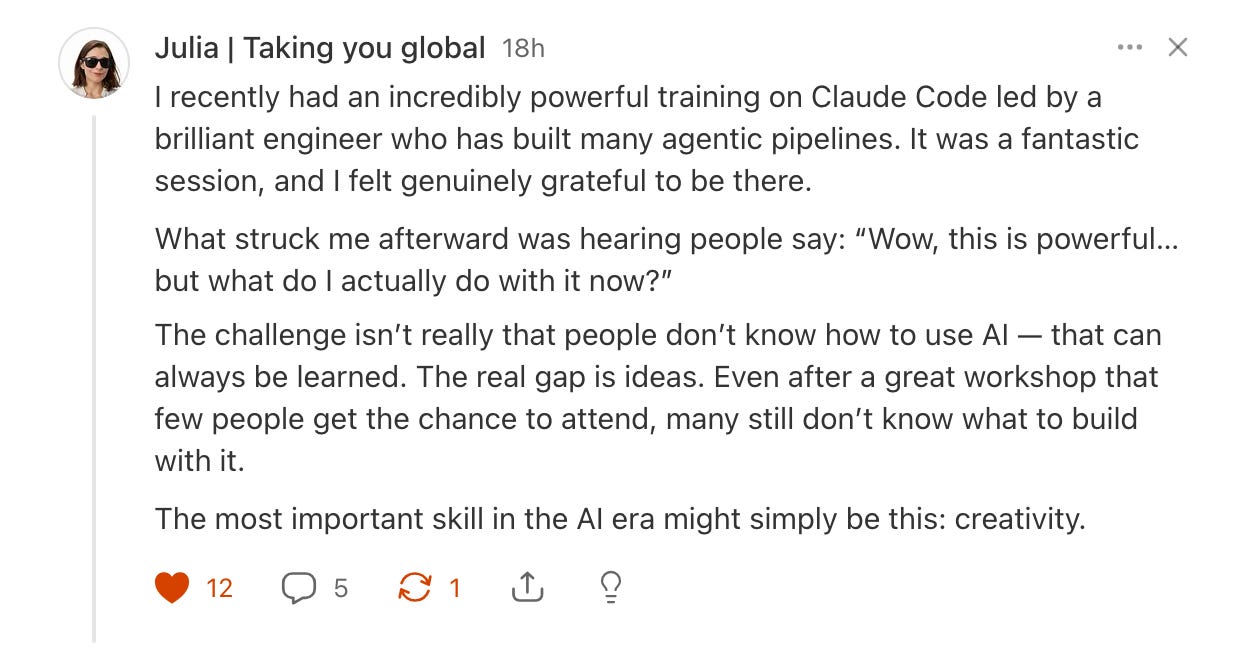
Sam and I are far from the only ones who’ve noticed this. Here’s a recent Substack note from Julia | Taking you global
Joel Salinas and Dawn Teh writing on the Leadership in Change Substack, state that cross-domain thinking is the essential leadership skill of the AI era. The framing was right, but I’d argue that the diagnosis missed something important. Cross-domain thinking isn’t a new skill that AI is demanding but rather an old capacity that AI is making harder to suppress.
When the barriers to creative production dissolve, when anyone can prototype, write, visualise, code, the differentiator shifts from execution to judgement. From technical skill to the ability to bring original thinking to a real problem.
That’s not a new insight. Osborn named it in 1953. What’s new is that as an individual, a team, or an organisation, you are out of excuses.
Some will object that AI makes this argument obsolete. If machines can generate creative output at scale, why develop a capacity that they will outperform? The answer is in the question. When the barriers to creative production dissolve for everyone simultaneously, output becomes abundant, and judgement becomes scarce. Someone still has to decide what good looks and feels like. That evaluation is aesthetic, emotional and contextual. It has no fixed answer. It’s the vibe argument again: the felt sense of quality before you can prove it. AI doesn’t replace that, it makes it the only differentiator that remains.
So what does creative recovery actually look like?
Think of it in three layers.
Layer 1: What you bring
Creative ability: the underlying cognitive capacity that everyone has
Creative mindset: openness to uncertainty and ambiguity
Creative confidence: the belief that your original thinking is worth something
Creative literacy: enough understanding of how creativity actually works to engage with it deliberately
Layer 2: What turns potential into practice
Skills, processes, judgement and discipline: the craft layer
Culture: the environment around you
Collaboration: the quality of the people you’re working with
Layer 3: What works when it works
Competence: you can do it reliably
Fluency: you can do it without effort
Attainment: work that solves the problem in a way nobody else would have found
Most organisations skip the first two layers entirely. They invest in workshops, innovation sprints, hackathons or offsite days with sticky notes. None of it addresses whether the conditions for creative thinking exist in the first place.
The entry point isn’t a tool or a technique. It’s a decision. Deciding you were wrong about yourself, your team, and your organisation.
The Decision Lab aren’t advertising for a rare specialist; they’re describing a new baseline.
The creative technologist is someone who brings original thinking to real problems, who moves across domains, who treats uncertainty as the operating condition rather than the obstacle.
This is not a special talent but your innate capability.
Whether you work for yourself, within a small team, or a large organisation, or an institution, the people you work with and for are going to need you to bring your creativity with you, because increasingly, that will become the minimum requirement needed to succeed.
You were in the 98% once. The question isn’t whether you can get back there. The question is, what are you waiting for?
References
George Land — “The Failure of Success,” TEDx Tucson, 2011. Original NASA creativity test and longitudinal study of 1,600 children across three decades.
Scott Barry Kaufman and Ronald Beghetto — “Beyond Big and Little: The Four C Model of Creativity.” Review of General Psychology, Vol. 13, 2009.
Sir John Hegarty — Pure vs applied creative distinction. Co-founder of Bartle Bogle Hegarty (BBH).
Alex Osborn — Applied Imagination: Principles and Procedures of Creative Problem-Solving. Scribner, 1953. Co-founder of BBDO.
Brian Eno and Bette Adriaanse — What Art Does: An Unfinished Theory. Faber & Faber, 2025.
Christian Werner, Lisa Min Tang, Joel Schmidt, Adrian Mielke, Matthias Spörrle, Heinz Neber, Zuoyu Zhou, Xiangyang Zhao and Guikang Cao — “Applied Creativity Across Domains and Cultures: Integrating Eastern and Western Perspectives.” Creative Personality, Vol. 9, 2011, pp. 228–240.
World Economic Forum — The Future of Jobs Report 2025, Skills Outlook. Creative thinking ranked #4 core skill required by employers, 2025–2030.
Martin Seligman and Steven Maier — “Failure to Escape Traumatic Shock.” Journal of Experimental Psychology, Vol. 74, 1967.
Ralph Stacey — Strategic Management and Organisational Dynamics. 7th edition, Pearson, 2016.
Piercosma Bisconti, Matteo Prandi, Federico Pierucci, Francesco Giarrusso, Marcantonio Bracale Syrnikov, Marcello Galisai, Vincenzo Suriani, Olga Sorokoletova, Federico Sartore, Daniele Nardi — Adversarial Poetry as a Universal Single-Turn Jailbreak Mechanism in Large Language Models. ArXiv preprint, 2025.
Julia Diez — Substack note on the creativity gap in AI adoption. Julia | Taking you global , 2026.
 | A guest post by
|
Thanks so much for the opportunity to collaborate to this post Des and also for the thought provoking insights into what it means to be both technical and creative. 🙏
Really enjoyed this you two. That NASA finding is staggering!